
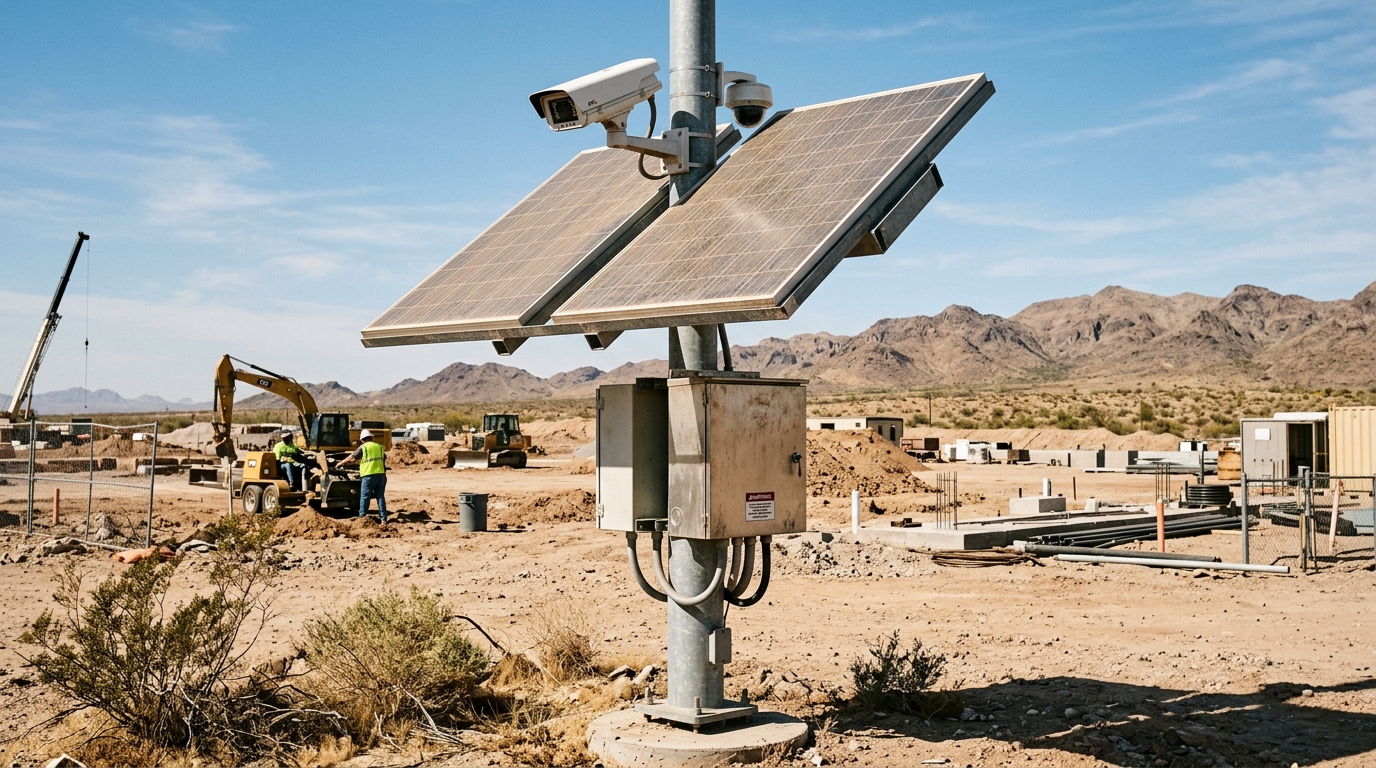
Here's the reality of most Phoenix construction sites: you need security cameras yesterday, there's no electrical grid within 500 feet, and you don't have three weeks to wait for permits and electricians. That's exactly why solar powered security cameras have become the default choice for Arizona contractors.
We've deployed thousands of solar camera systems across Phoenix metro construction sites — from downtown infill projects to master-planned communities out past Buckeye. Here's what actually matters when you're choosing and deploying solar surveillance for your job site.
Why Solar Cameras Dominate Phoenix Construction Security
Let's start with the obvious: Arizona gets 299 sunny days per year. If there's any place on Earth where solar-powered equipment makes sense, it's here. But sunshine isn't the only reason:
- No electrical infrastructure needed. Most active construction sites don't have permanent power yet — or if they do, it's in the wrong spots. Solar cameras go wherever you need them, no extension cords, no generators, no electricians.
- Rapid deployment. A solar camera tower can be set up and streaming within 2-4 hours. Try getting a grid-powered camera system installed that fast.
- Zero utility costs. The sun doesn't send invoices. Over a 12-month project, the electricity savings add up.
- Relocatable. As your project phases change — foundation to framing to finish-out — you can move solar cameras to where they're needed most. A hardwired camera stays where you bolted it.
How Solar Powered Security Cameras Actually Work
There's a lot of confusion about solar cameras, so let's break down the components:
The Solar Panel
Modern construction-grade solar camera systems use 100W-300W monocrystalline panels. At Phoenix's solar irradiance levels (averaging 6.5 peak sun hours daily), a 200W panel generates roughly 1,300Wh per day — more than enough to power a 4G-connected camera running 24/7.
The panels we deploy are tempered glass with aluminum frames, rated for hail, wind loads up to 120 mph, and the relentless UV exposure that destroys lesser equipment in one Arizona summer.
The Battery Bank
This is where cheap solar cameras fail. The battery is what keeps your camera running through the night, during monsoon storms, and on those rare overcast stretches in winter.
Quality systems use lithium iron phosphate (LiFePO4) batteries — not the lithium-ion cells you'd find in a laptop. LiFePO4 handles extreme heat far better. Standard lithium-ion degrades rapidly above 113°F. LiFePO4 maintains performance up to 140°F, which matters when your battery enclosure is sitting in direct Phoenix sun.
We spec batteries for 5-7 days of autonomous operation without any solar input. In Phoenix, you'll almost never need that reserve, but it means your cameras keep rolling through monsoon week when you get four cloudy days in a row.
The Camera
Most solar camera towers run PTZ (pan-tilt-zoom) cameras with:
- 4MP-8MP resolution (4K for premium setups)
- 30x-40x optical zoom — enough to read a license plate from 300 feet
- IR night vision to 300+ feet
- Wide dynamic range for the harsh sun/shadow contrasts on construction sites
- IP67 weather rating minimum
The Connectivity
Solar cameras connect via 4G LTE cellular — no Wi-Fi infrastructure needed. The camera streams live video and sends alerts to your phone or computer from anywhere with cell coverage. In the Phoenix metro, coverage is essentially universal.
For remote sites (think new subdivisions out past Maricopa or Anthem), we verify cell signal strength before deployment. In rare dead spots, we can add external high-gain antennas to boost the signal.
The 115°F Question: Do Solar Cameras Survive Phoenix Summers?
This is the question every contractor asks, and the honest answer is: the good ones do, the cheap ones don't.
Here's what separates construction-grade solar cameras from the $300 units on Amazon:
- Operating temperature range: Commercial systems are rated -40°F to 140°F. Consumer cameras typically max out at 113°F — a temperature Phoenix exceeds regularly from May through September.
- Battery chemistry: LiFePO4 vs. standard lithium-ion, as mentioned above. This is the #1 failure point for cheap solar cameras in Arizona.
- Thermal management: Good enclosures have ventilation, heat-reflective coatings, and thermal cutoff protection. Bad ones are sealed metal boxes that become ovens.
- Panel quality: Cheap panels use EVA encapsulant that yellows and delaminates in extreme UV. Quality panels use PET or double-glass construction.
We've had the same solar camera towers running on consecutive projects across multiple Phoenix summers without failure. The key is starting with equipment designed for this climate, not hoping consumer gear will hold up. For a deeper dive on heat performance, check out our article on how solar cameras handle Arizona's extreme heat.
Best Deployment Locations on a Construction Site
Where you put your solar cameras matters as much as which cameras you buy. Based on hundreds of Phoenix site deployments, here are the positions that deliver the most security value:
- Main entry/exit gate: Non-negotiable. Capture every vehicle and person entering or leaving. Position the camera to catch license plates on incoming vehicles.
- Material staging areas: This is where the expensive stuff sits — copper, appliances, fixtures. A camera here prevents the most common type of construction theft.
- Equipment yard: Excavators, generators, and scissor lifts are high-value targets, especially on weekends.
- Model homes / finished units: Once drywall is up and finishes start going in, these become targets for appliance and fixture theft.
- Perimeter weak points: Adjacent to roads, alleys, or open desert where access is easy. Use the camera's zoom capability to cover long fence lines.
For a comprehensive placement guide, see our article on the 10 best places to put security cameras on a construction site.
Solar Camera Rental vs. Purchase for Contractors
Most Phoenix contractors rent solar camera systems rather than buying. Here's why renting usually wins:
- No capital outlay: A quality solar camera tower costs $8,000-$15,000 to buy. Renting is a fraction of that, billed monthly.
- Maintenance included: Panel cleaning, battery replacement, firmware updates, camera re-aiming — all included in the rental.
- Always current technology: When you rent, you get the latest cameras and panels. Own them, and you're stuck with 2024 tech in 2028.
- Cellular data included: Rental includes the 4G data plan. Buying means managing your own cellular accounts.
The break-even point is typically around 24-30 months. If your project is shorter than that — and most are — renting makes more financial sense.
What to Look For in a Solar Camera Provider
Not all solar camera rental companies are equal. Here's what separates the professionals from the fly-by-night operators:
- Same-day or next-day deployment: Your site shouldn't be unprotected for a week while someone orders equipment.
- 24/7 live monitoring option: Cameras are good. Cameras backed by a live monitoring team that can dispatch police? Better.
- Local Phoenix presence: When a camera goes down at 2 PM on a Friday in July, you want a tech who can be there in hours, not days.
- Flexible contracts: Month-to-month terms, easy relocation, and the ability to add or remove cameras as your project evolves.
- Arizona experience: A provider who's deployed solar cameras in Wisconsin doesn't understand the specific challenges of 120°F surface temps, haboobs, and monsoon microbursts.
Get Solar Cameras on Your Phoenix Job Site
If you've got an active construction site in the Phoenix metro — or anywhere in Arizona — solar powered security cameras are the fastest, most reliable way to protect it. No power, no wiring, no waiting.
Contact STG for a free site assessment or use our Rent Now tool to configure your solar camera system and get a quote in minutes. We deploy within 24 hours across the entire Phoenix metro.
Call (480) 343-1325 — we've been protecting Arizona construction sites since 2000.
Need Help With Your Project?
Our team has been protecting Arizona properties since 2000. Whether you need a temporary rental or a permanent install, we\'re here to help.